Quick Answer: How does Varnish caching for WordPress work? Varnish caching for WordPress works through a defined WordPress, server, or browser process that changes how a site handles this problem. Diagnose the responsible layer, apply one reversible change, and verify the public result with settings, logs, headers, or a repeatable test.
| Varnish caching for WordPress | WP Rocket |
|---|---|
| Directly addresses the primary problem or decision in this article. | Uses a different workflow, product, or trade-off for a related outcome. |
| Best when its control, compatibility, maintenance, and evidence fit the site. | Best when simplicity, portability, performance, or another project constraint matters more. |
Use Varnish caching for WordPress when the reader has a specific goal
Start with the outcome the reader wants, not with a feature list. For Varnish caching for WordPress, identify the page, audience, workflow, or decision involved, then check the active theme, plugins, hosting, mobile experience, analytics, and caching before changing production settings.
Record the current state and test one representative example first. This makes the result easier to verify and gives you a defensible rollback point if the change affects visitors, search visibility, forms, or revenue.
Use Varnish caching for WordPress to compare the practical tradeoffs
The closest alternative is WP Rocket, but the right choice depends on the job rather than brand familiarity. Compare control, compatibility, accessibility, performance, support, exportability, security, recurring maintenance, and the cost of changing direction later.
A professional decision names who should use the option, who should avoid it, and what evidence would change the recommendation. That is more useful than calling one tool the universal winner.
Use Varnish caching for WordPress and verify the result
After applying the advice, test the same public URL or workflow as the same type of visitor who reported the issue. Check desktop and mobile layouts, browser console errors, forms, login, search, and any cache or redirect headers relevant to the topic.
Do not treat a successful dashboard action as proof that the public experience is correct. Keep a short change note with the date, versions, URLs tested, result, and rollback path.
Technical example: verify cache and redirect behavior
Test the response as a logged-out visitor and inspect headers rather than relying on the visual page alone. The first request may be a miss; the second request should show whether a public cache can serve the same URL.
Header check example
curl -I https://example.com/sample-post/
curl -I https://example.com/sample-post/
Look for a single redirect, a stable canonical URL, cache status headers, cookies, and a suitable Cache-Control policy. Exclude login, cart, checkout, account, and other private pages from shared page caching.
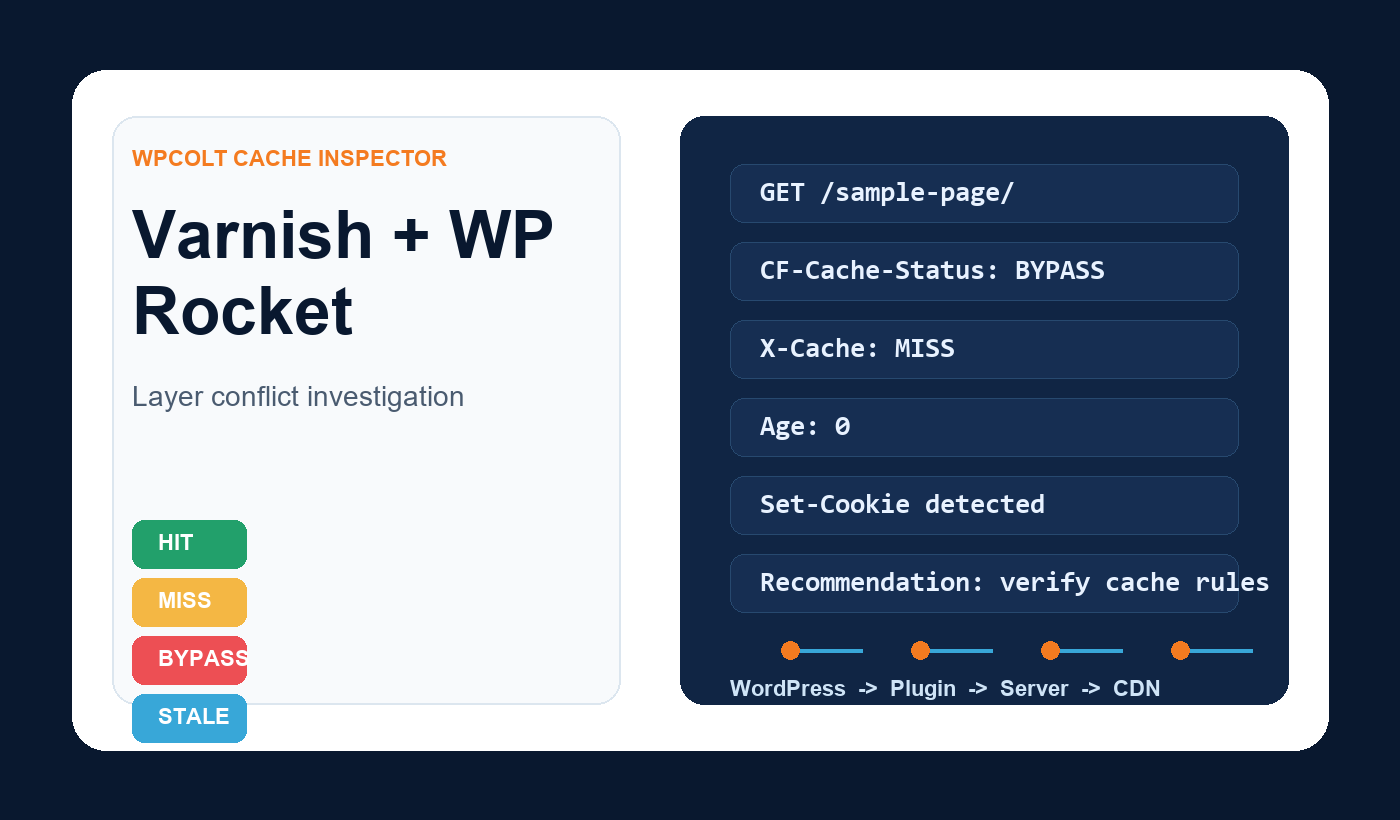
Running two page caches is a recipe for disaster. We show you how to resolve the conflict.
What I would check first
In practical WordPress audits, the same pattern comes up again and again: a site owner installs a plugin, changes a theme, adds a translation layer, turns on a CDN, or follows an old tutorial, then judges the result from the admin session. That is dangerous because logged-in users often bypass cache, see different scripts, and skip the exact visitor path that matters.
How to diagnose the cache layer
Start with a clean logged-out request and record the headers. If the first request is MISS and the second request is HIT, the basic page cache is probably working. If both requests bypass, look for cookies, query strings, logged-in assumptions, dynamic fragments, or cache-control headers that prevent storage. If the response is HIT but the content is stale, the problem is invalidation rather than cache creation.
What usually goes wrong
The most common mistake is stacking tools without assigning ownership. A plugin cache, server cache, CDN cache, browser cache, and object cache can all help, but only when each has a clear job. If multiple layers try to purge, vary, or bypass the same page differently, the site owner sees random behavior and loses confidence.
How to verify the fix
After making a change, clear only the relevant layer if possible, then request the same URL twice. Confirm the response body is current, the headers match the expected state, and private pages still bypass. Do not mark the issue solved because the admin view looks correct. The public response is what matters.
Decision framework
| Area | What to check |
|---|---|
| Cache layer | Look for page cache, object cache, server cache, CDN, and browser cache acting on the same request. |
| Header evidence | Check Age, X-Cache, CF-Cache-Status, X-Varnish, Cache-Control, Set-Cookie, and Vary. |
| Visitor state | Compare logged-out, logged-in, cart/account, and query-string requests separately. |
| Verification | Request the same URL twice after clearing cache and compare headers, timing, and body freshness. |
Common mistakes to avoid
- Following an old tutorial without checking whether WordPress, the plugin, or the host has changed.
- Testing only while logged in as an administrator.
- Installing a second tool before identifying which tool owns the current behavior.
- Ignoring cache, CDN, object cache, and browser cache when judging whether a fix worked.
- Choosing a theme or plugin from a demo without testing real content, forms, archives, and mobile layouts.
Final recommendation
If the issue touches caching, stale content, redirects, plugin conflicts, Cloudflare, Varnish, Redis, or object cache, the safest next step is diagnostic rather than decorative. Prove which layer is responsible, fix that layer, and keep the stack simpler afterward.
What I would check first
In practical WordPress audits, the same pattern comes up again and again: a site owner installs a plugin, changes a theme, adds a translation layer, turns on a CDN, or follows an old tutorial, then judges the result from the admin session. That is dangerous because logged-in users often bypass cache, see different scripts, and skip the exact visitor path that matters.
How to diagnose the cache layer
Start with a clean logged-out request and record the headers. If the first request is MISS and the second request is HIT, the basic page cache is probably working. If both requests bypass, look for cookies, query strings, logged-in assumptions, dynamic fragments, or cache-control headers that prevent storage. If the response is HIT but the content is stale, the problem is invalidation rather than cache creation.
What usually goes wrong
The most common mistake is stacking tools without assigning ownership. A plugin cache, server cache, CDN cache, browser cache, and object cache can all help, but only when each has a clear job. If multiple layers try to purge, vary, or bypass the same page differently, the site owner sees random behavior and loses confidence.
How to verify the fix
After making a change, clear only the relevant layer if possible, then request the same URL twice. Confirm the response body is current, the headers match the expected state, and private pages still bypass. Do not mark the issue solved because the admin view looks correct. The public response is what matters.
Decision framework
| Area | What to check |
|---|---|
| Cache layer | Look for page cache, object cache, server cache, CDN, and browser cache acting on the same request. |
| Header evidence | Check Age, X-Cache, CF-Cache-Status, X-Varnish, Cache-Control, Set-Cookie, and Vary. |
| Visitor state | Compare logged-out, logged-in, cart/account, and query-string requests separately. |
| Verification | Request the same URL twice after clearing cache and compare headers, timing, and body freshness. |
Common mistakes to avoid
- Following an old tutorial without checking whether WordPress, the plugin, or the host has changed.
- Testing only while logged in as an administrator.
- Installing a second tool before identifying which tool owns the current behavior.
- Ignoring cache, CDN, object cache, and browser cache when judging whether a fix worked.
- Choosing a theme or plugin from a demo without testing real content, forms, archives, and mobile layouts.
Final recommendation
If the issue touches caching, stale content, redirects, plugin conflicts, Cloudflare, Varnish, Redis, or object cache, the safest next step is diagnostic rather than decorative. Prove which layer is responsible, fix that layer, and keep the stack simpler afterward.
Implementation notes
The safest implementation keeps the change understandable. Record the setting, plugin, template, or service involved; make the change in a controlled environment when possible; clear the relevant cache; and check the same visitor path again. A useful result is one that another site owner can reproduce and maintain.