Quick Answer: What is Adsense Login Solution? Adsense Login Solution is the central concept or practical question addressed by this guide. It matters because WordPress decisions affect publishing, visitors, search visibility, security, speed, and maintenance. The answer should lead to a result that a site owner can check.
| Adsense Login Solution | a comparable WordPress alternative |
|---|---|
| Directly addresses the primary problem or decision in this article. | Uses a different workflow, product, or trade-off for a related outcome. |
| Best when its control, compatibility, maintenance, and evidence fit the site. | Best when simplicity, portability, performance, or another project constraint matters more. |
Use Adsense Login Solution when the reader has a specific goal
Start with the outcome the reader wants, not with a feature list. For Adsense Login Solution, identify the page, audience, workflow, or decision involved, then check the active theme, plugins, hosting, mobile experience, analytics, and caching before changing production settings.
Record the current state and test one representative example first. This makes the result easier to verify and gives you a defensible rollback point if the change affects visitors, search visibility, forms, or revenue.
Use Adsense Login Solution to compare the practical tradeoffs
The closest alternative is a comparable WordPress alternative, but the right choice depends on the job rather than brand familiarity. Compare control, compatibility, accessibility, performance, support, exportability, security, recurring maintenance, and the cost of changing direction later.
A professional decision names who should use the option, who should avoid it, and what evidence would change the recommendation. That is more useful than calling one tool the universal winner.
Use Adsense Login Solution and verify the result
After applying the advice, test the same public URL or workflow as the same type of visitor who reported the issue. Check desktop and mobile layouts, browser console errors, forms, login, search, and any cache or redirect headers relevant to the topic.
Do not treat a successful dashboard action as proof that the public experience is correct. Keep a short change note with the date, versions, URLs tested, result, and rollback path.
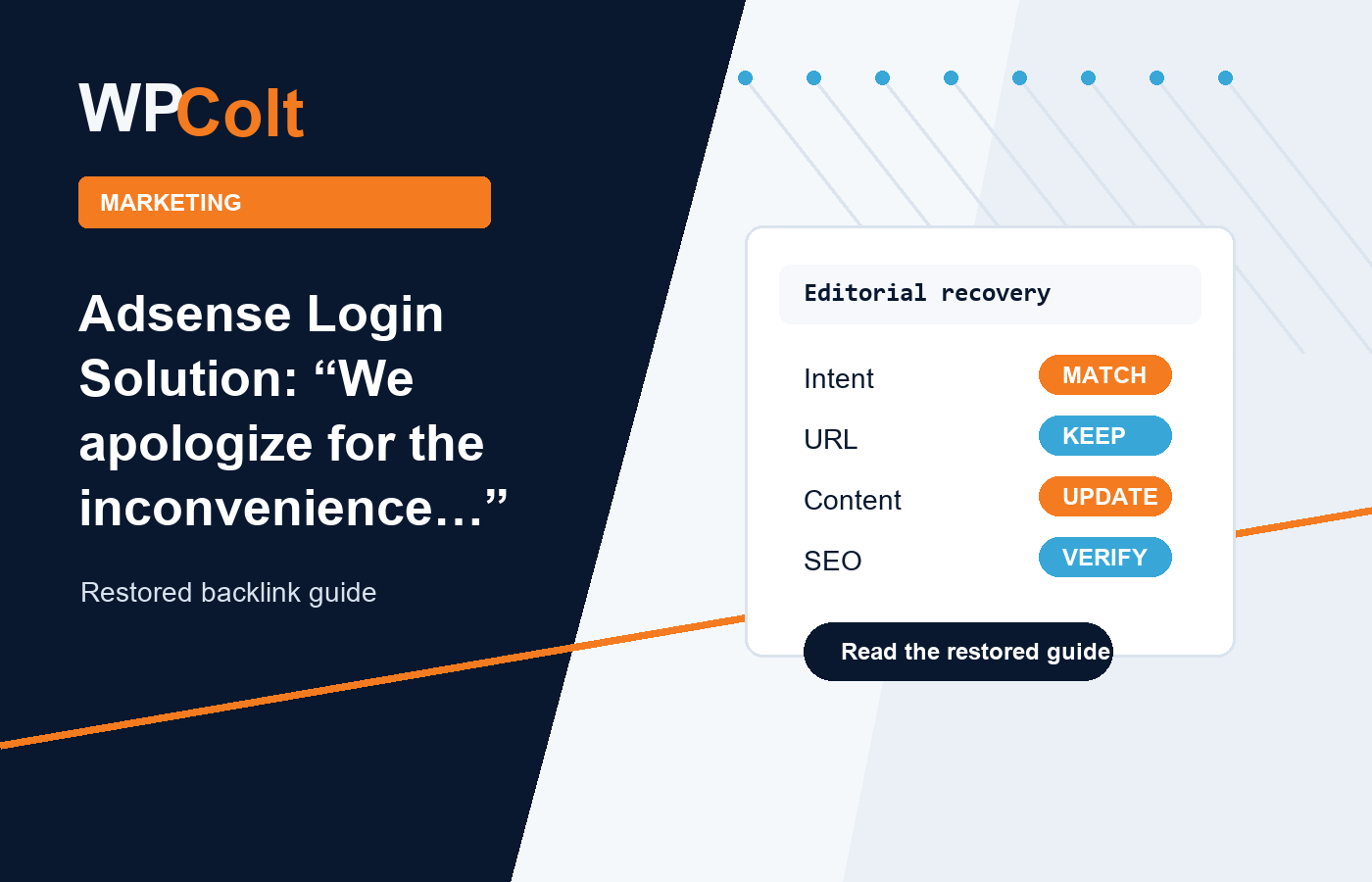
The updated version is written for site owners, editors, and agencies who need practical guidance rather than an abandoned archive page. It keeps the URL alive while making the content useful again.
Marketing without eroding trust
For Adsense Login Solution: “We apologize for the inconvenience…”, the strongest result comes from consent, relevance, and measurement. Email lists, ads, popups, affiliate links, and lead magnets should help visitors instead of interrupting them blindly.
Marketing tools can also affect performance and cache. Scripts, cookies, personalization, and tracking parameters can cause public pages to bypass cache or fragment analytics. Keep the stack lean and document why each tool is present.
Decision checklist
| Step | Practical check |
|---|---|
| Identify intent | Write down what the visitor expected when they clicked the old backlink. |
| Check current stack | Theme, plugins, hosting, CDN, cache, analytics, ecommerce, and multilingual tools can all change the answer. |
| Make one change | Avoid changing multiple layers before you know which one caused the issue. |
| Verify | Retest as the right visitor type and document what changed. |
Common mistakes
- Copying an old tutorial without checking current WordPress behavior.
- Installing another plugin before identifying which layer is responsible.
- Judging a theme, builder, or service only from its demo page.
- Changing URLs that already have backlinks instead of improving the page in place.
- Testing only while logged in as an administrator.
Final recommendation
What I would check first
In practical WordPress audits, the same pattern comes up again and again: a site owner installs a plugin, changes a theme, adds a translation layer, turns on a CDN, or follows an old tutorial, then judges the result from the admin session. That is dangerous because logged-in users often bypass cache, see different scripts, and skip the exact visitor path that matters.
Trust before tactics
Marketing works better when visitors understand what they get and why they should care. Popups, email forms, affiliate links, social ads, and lead magnets should support a clear promise. If they distract from the page or slow it down, they are not helping.
Measurement without bloat
Every tracking script should have a job. Analytics, pixels, heatmaps, chat widgets, and A/B testing tools can stack up quickly, and each can add cookies or scripts that affect performance and caching. Keep the stack intentional.
Content that compounds
The best marketing pages answer real questions, preserve useful URLs, and link to related resources. A updated backlink article can become part of that system when it is updated with current context and a clear next step.
Decision framework
| Area | What to check |
|---|---|
| Intent | Define what the visitor is trying to solve before recommending a tool or tactic. |
| Risk | Identify security, performance, SEO, cache, and maintenance consequences. |
| Action | Make one controlled change with a rollback path. |
| Verification | Test the result as the real visitor or user type. |
Common mistakes to avoid
- Following an old tutorial without checking whether WordPress, the plugin, or the host has changed.
- Testing only while logged in as an administrator.
- Installing a second tool before identifying which tool owns the current behavior.
- Ignoring cache, CDN, object cache, and browser cache when judging whether a fix worked.
- Choosing a theme or plugin from a demo without testing real content, forms, archives, and mobile layouts.
Final recommendation
If the issue touches caching, stale content, redirects, plugin conflicts, Cloudflare, Varnish, Redis, or object cache, the safest next step is diagnostic rather than decorative. Prove which layer is responsible, fix that layer, and keep the stack simpler afterward.
What I would check first
In practical WordPress audits, the same pattern comes up again and again: a site owner installs a plugin, changes a theme, adds a translation layer, turns on a CDN, or follows an old tutorial, then judges the result from the admin session. That is dangerous because logged-in users often bypass cache, see different scripts, and skip the exact visitor path that matters.
Trust before tactics
Marketing works better when visitors understand what they get and why they should care. Popups, email forms, affiliate links, social ads, and lead magnets should support a clear promise. If they distract from the page or slow it down, they are not helping.
Measurement without bloat
Every tracking script should have a job. Analytics, pixels, heatmaps, chat widgets, and A/B testing tools can stack up quickly, and each can add cookies or scripts that affect performance and caching. Keep the stack intentional.
Content that compounds
The best marketing pages answer real questions, preserve useful URLs, and link to related resources. A backlink article can become part of that system when it has current context and a clear next step.
Decision framework
| Area | What to check |
|---|---|
| Intent | Define what the visitor is trying to solve before recommending a tool or tactic. |
| Risk | Identify security, performance, SEO, cache, and maintenance consequences. |
| Action | Make one controlled change with a rollback path. |
| Verification | Test the result as the real visitor or user type. |
Common mistakes to avoid
- Following an old tutorial without checking whether WordPress, the plugin, or the host has changed.
- Testing only while logged in as an administrator.
- Installing a second tool before identifying which tool owns the current behavior.
- Ignoring cache, CDN, object cache, and browser cache when judging whether a fix worked.
- Choosing a theme or plugin from a demo without testing real content, forms, archives, and mobile layouts.
Final recommendation
If the issue touches caching, stale content, redirects, plugin conflicts, Cloudflare, Varnish, Redis, or object cache, the safest next step is diagnostic rather than decorative. Prove which layer is responsible, fix that layer, and keep the stack simpler afterward.